Paging in ASP.NET Core MVC
Problem definition: When we fetch thousands of records from the database, we cannot show them all in one MVC grid, for readability and performance. We show a limited number of records and add paging with page numbers, so users can move through the records easily. Here we implement that paging logic.
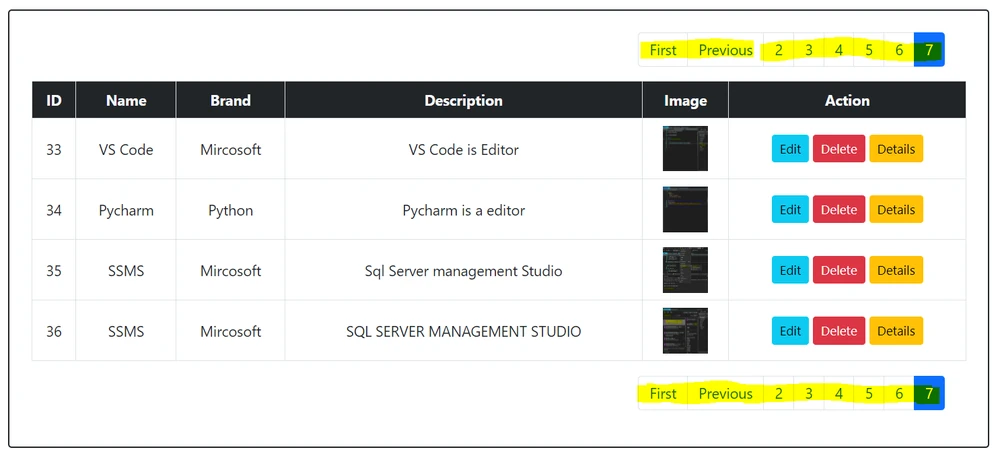
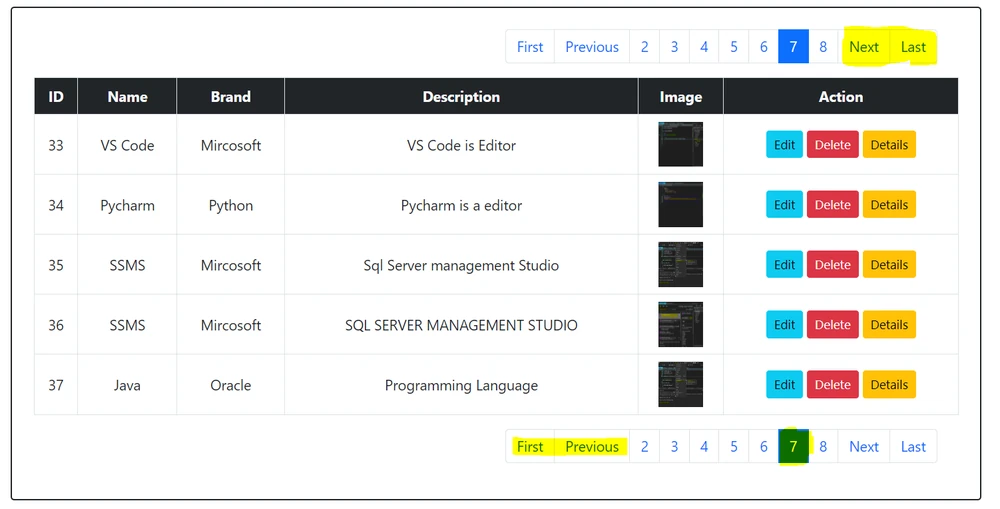
Implementation: To implement paging, follow the steps below.
- Create a model class for items.
- Create a controller named Items.
- Add this Item model class to the DbContext class and then run the migration commands.
- Create an action method named Index to list the items.
- Create a view for the Index method.
- Create a Pager class for the paging logic.
- Create a _Pager partial view for the pagination bar.
In the implementation phase, we create a model class for items. Below is the code for the Item model class.
public class Item

   {

       [Key]

       public int ItemId { get; set; }

       public string Name { get; set; }

       public string Brand { get; set; }

       public string Description { get; set; }

       public string Path { get; set; }

       [NotMapped]

       [Display(Name ="Choose Image")]

       public IFormFile ImagePath { get; set; }

   }
Below is the code for the Pager class.
public class Pager

   {

       public int TotalItems { get; set; }

       public int PageSize { get; set; }

       public int CurrentPage { get; set; }

       public int TotalPages { get; set; }

       public int StartPage { get; set; }

       public int EndPage { get; set; }

       public Pager()

       {


       }

       public Pager(int totalItems,int page,int pageSize=5)

       {

           int totalPages=(int)Math.Ceiling((decimal)totalItems/(decimal)pageSize);

           int currentPage = page;

           int startPage = currentPage - 5;

           int endPage = currentPage + 4;

           if(startPage<=0)

           {

               endPage=endPage-(startPage-1);

               startPage = 1;

           }

           if(endPage>totalPages)

           {

               endPage = totalPages;

               if(endPage>10)

               {

                   startPage = endPage - 9;

               }

           }

           TotalItems = totalItems;

           CurrentPage = currentPage;

           PageSize = pageSize;

           TotalPages = totalPages;

           StartPage = startPage;

           EndPage = endPage;

       }

   }
Now create a DbContext class named demoDBcontext and add the DbSet below. It generates the table in the database when you run the migration commands.
public DbSet<Item> Items { get; set; }Now create a controller named Items and write the action methods below in it. Index() fetches the list of records from the database and shows it in the view.
 public class ItemsController : Controller

    {

        private readonly AmazonShoppingDBContext _db;

        private readonly IWebHostEnvironment webHostEnvironment;

        public ItemsController(AmazonShoppingDBContext db,IWebHostEnvironment environment)

        {

            _db = db;

            webHostEnvironment = environment;


        }


        public IActionResult Index(int pg=1)

        {

            var data = _db.Items.ToList();

            const int pageSize = 5;

            if (pg < 1)

                pg = 1;

            int recsCount = data.Count;


           var pager=new Pager(recsCount,pg,pageSize);

            int recSkip = (pg - 1) * pageSize;

            var dataList=data.Skip(recSkip).Take(pager.PageSize).ToList();

            ViewBag.Pager=pager;

            return View(dataList);

        }

}
List of Items to present into grid: We implemented an action method, Index, that retrieves the item records from the database table into a list and returns them to the view. Below is the code for the controller action method.
        public IActionResult Index(int pg=1)

        {

            var data = _db.Items.ToList();

            const int pageSize = 5;

            if (pg < 1)

                pg = 1;

            int recsCount = data.Count;


           var pager=new Pager(recsCount,pg,pageSize);

            int recSkip = (pg - 1) * pageSize;

            var dataList=data.Skip(recSkip).Take(pager.PageSize).ToList();

            ViewBag.Pager=pager;

            return View(dataList);

        }

}
Pager Partial View: This view renders the pagination bar with the First, Previous, Next and Last buttons.
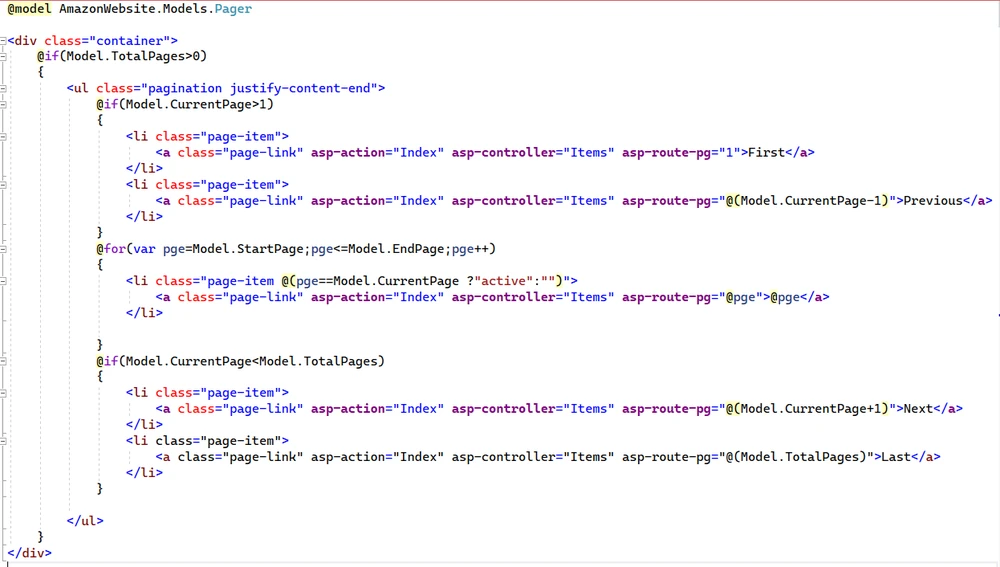
Index View: Design the Index view to show the item list in a grid, and use the pager partial view for the pagination bar, as shown in the image below.
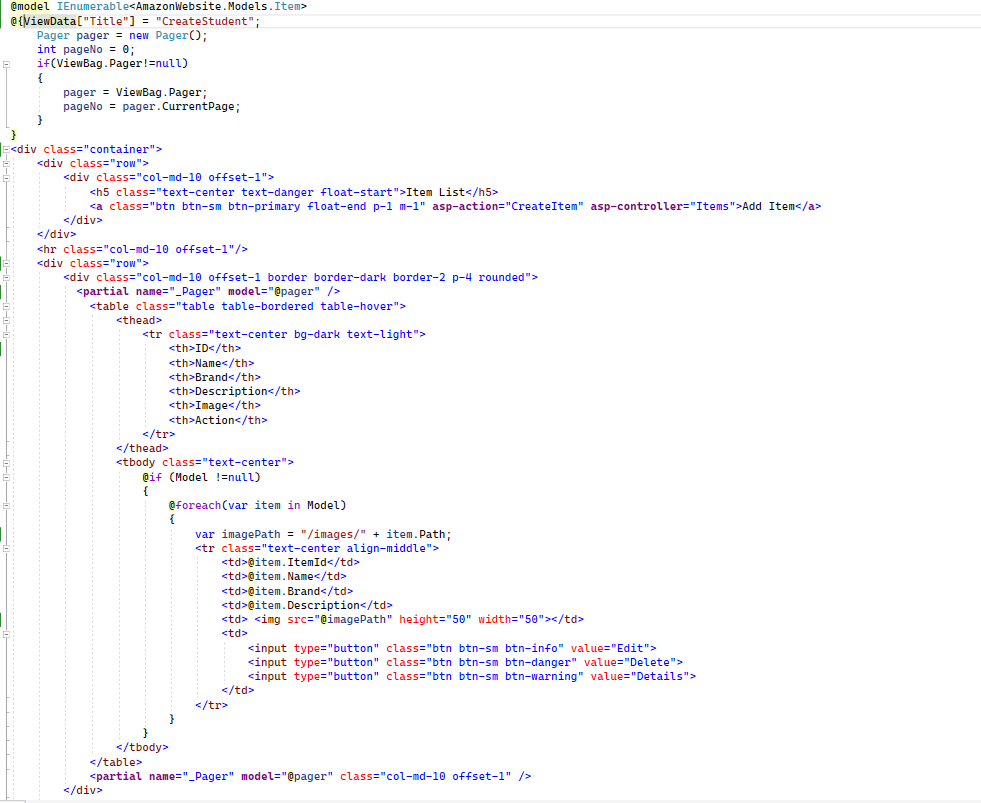
We have now implemented the paging logic; you can test it on your local machine.