Custom Middleware in ASP.NET Core MVC
Middleware is a piece of code used in the application pipeline to process incoming requests and their responses. Some middleware components are built into .NET Core, and we can also create custom middleware based on our requirements. Middleware is usually written as a class and registered through an extension method. Request delegates are used to build the request pipeline.
Problem definition: When a user requests the URL "/Home/Index", custom middleware should redirect them to the "/Home/CustomError" page instead.
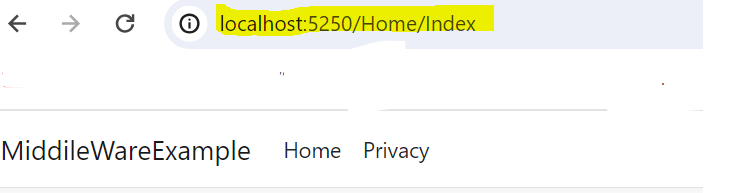
In the image below you can see the URL, in which Home is the controller and Index is the action method. When we open this URL, it shows the Index page.
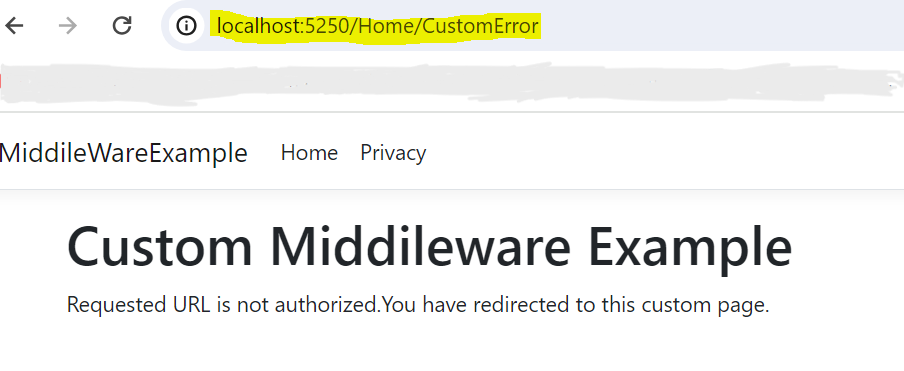
After adding the middleware, opening the URL above redirects to the Home/CustomError page.
Create a class named CheckUrlValidations with a constructor that stores the RequestDelegate. Write the InvokeAsync method with the URL-checking logic, then create an extension method UseCheckUrlValidations, as shown in the image and code below.
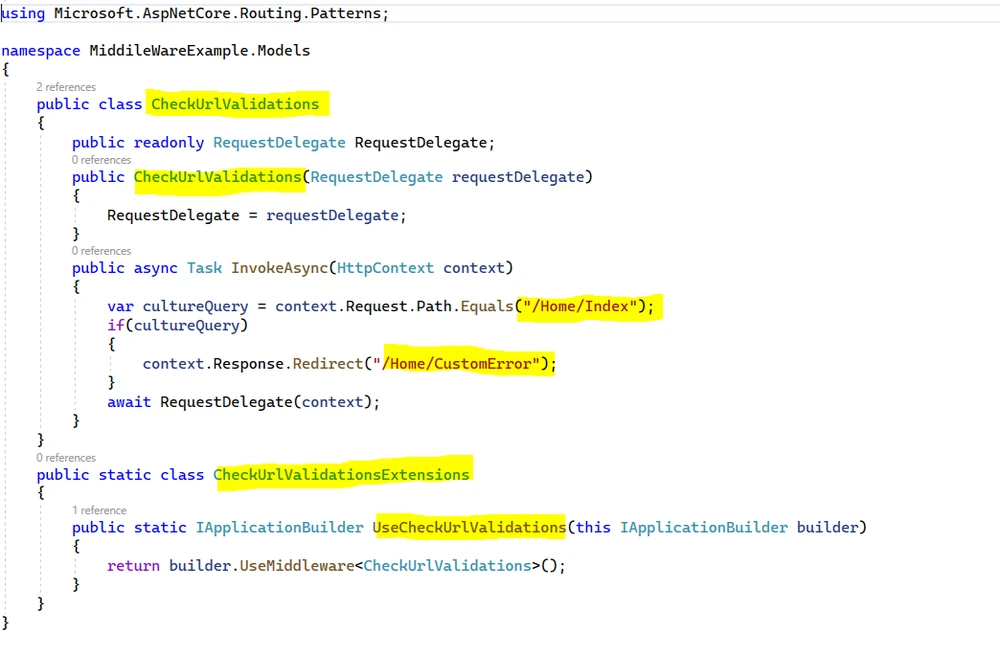
public class CheckUrlValidations

   {

       public readonly RequestDelegate RequestDelegate;

       public CheckUrlValidations(RequestDelegate requestDelegate)

       {

           RequestDelegate = requestDelegate;

       }

       public async Task InvokeAsync(HttpContext context)

       {

           var cultureQuery = context.Request.Path.Equals("/Home/Index");

           if(cultureQuery)

           {

               context.Response.Redirect("/Home/CustomError");

           }

           await RequestDelegate(context);

       }

   }

   public static class CheckUrlValidationsExtensions

   {

       public static IApplicationBuilder UseCheckUrlValidations(this IApplicationBuilder builder)

       {

           return builder.UseMiddleware<CheckUrlValidations>();

       }

   }
Now use this custom middleware in the Program.cs file, as shown in the image and code below.
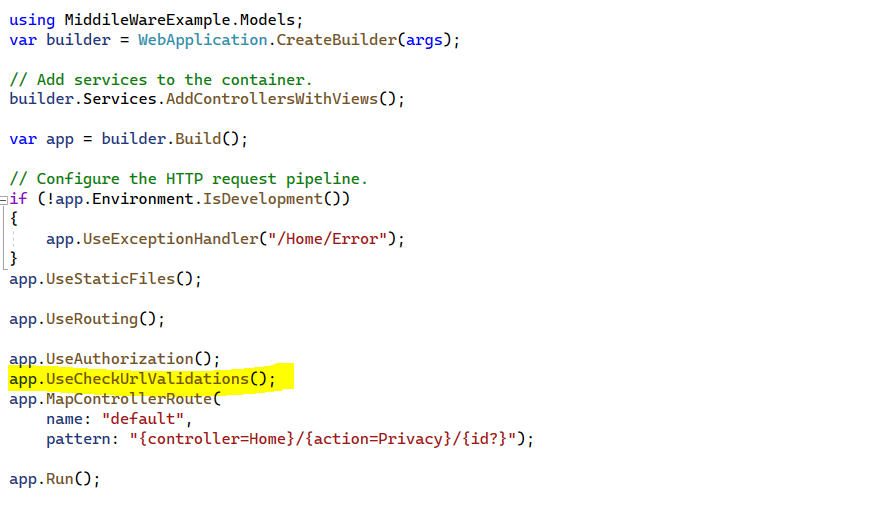
using MiddileWareExample.Models;

var builder = WebApplication.CreateBuilder(args);


// Add services to the container.

builder.Services.AddControllersWithViews();


var app = builder.Build();


// Configure the HTTP request pipeline.

if (!app.Environment.IsDevelopment())

{

    app.UseExceptionHandler("/Home/Error");

}

app.UseStaticFiles();


app.UseRouting();


app.UseAuthorization();

app.UseCheckUrlValidations();

app.MapControllerRoute(

    name: "default",

    pattern: "{controller=Home}/{action=Privacy}/{id?}");


app.Run();